Jan Matthesius
 
Helena Schepens
 
Paul de Vries
home organisation activities news - agenda contact dutch
           
  Participants “Program of Excellence”


  Events
   
Exhibitions of silver art are held throughout the year at zilvergalerie de Watertoren, Studio 925/ zilver en van Nouhuys and the Silvermuseum.

11 – 18 april 2010 Zilvergalerie De Watertoren takes part at The new Art-and Antique Fair


The exhibition programme:

24 May 2010, National Silverday Schoonhoven, see for information

21 – 28 nov. 2010 Pan Amsterdam Participants Studio 925 and Galerie de Watertoren

27 april - 29 augustus 2010 "Van Kempen & Begeer" Silvermuseum

12 september - 21 november 2010 "Als zilver spreken kan"Verrassingen uit particuliere verzamelingen. Expositie van de Nederlandse zilverclub. 

   
  Agenda / news
   
The Benchpeg Newsletter, Issue 169: 27th June - 3rd July 2010 [PDF]
   
  Short interview with E.Auriol Peers
   
[Welman] In an article in Benchpeg you call your year in The Netherlands different from anything you have done in England.
You mention differences such as buildings and the use of tools. Are there also differences in the training itself?

[Elizabeth] The big difference between my experiences at Bishopsland and Silver In Motion is the presence of the teacher silversmiths. They are always there and working beside you. You see them at work the whole day.

At Bishopsland your contact with a tutor, who visits for the day, is only about 20 minutes.
Also the Dutch have a certain bluntness in their behavior towards people and she emphasizes that she likes this bluntness because it sometimes helped in the explaining of ideas.

The art fairs in Holland [part of the program of excellence] are very different from the art fairs in England because over there the silver is divided in categories like traditional or modern but never all categories at once.

   
[W] Your inspiration is ‘the beauty found within facial scaring and disfigurement’. Do you think that you can call this theme typically feminine?
[E] No, not really, I feel either sex can be affected by this theme. My reason for choosing this particular theme/my inspiration for my work has been a slow gathering of information from my subconscious. It has been what I have been moved by as I have grown up. It was in Holland that I had time to piece together all my encounters and realized what my work was really about. I had time to listen to what I was really thinking and feeling. One of my encounters has been with the father of a close friend of mine. This man (James) had an accident when he was only 18years old and has been badly disfigured since. Knowing him, and his charity Changing Faces has made a huge impression on me. When I came to Schoonhoven I had the time to develop my ideas around this theme and explore what is important to me about my work and about the beauty that can be found within disfigurement. I wanted to give more meaning to the objects I was making, I wanted to make them more than just meaningless objects of function.

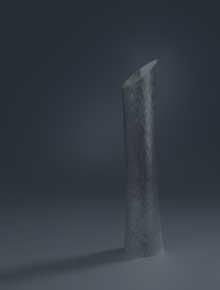
[[W] Can you explain why James is shaped like a vase?
[E] James is to me more like a sculpture then an object like a vase.. During the designing stage I never once thought ‘I shall make a vase, and it will be called James’. A piece develops over time and certain things influence it. I did not necessarily want to make a functional piece. Looking back now, I believe the necessity for function has been ingrained in me throughout my education and therefore it affected my subconscious and designs.
The expression of the idea is my priority and the fact that you can use it is not very important. It took me roughly 3 months to make James, partly because of the size and partly because I had never created a piece of this ambition before. Of course, now if I were to make a similar piece I would be able to work a little faster as my technical skills have developed and I have a greater understanding for the way the metal moves and is worked. – As they say ‘Practice makes perfect”!!

   
[W] Where you able, whilst working in the various different workshops, to see any similarities and differences in the way the silversmiths work?
[E] Yes, of course, both silversmiths are very different. ‘How could they not be?!’ - Both of them are very different people with different responsibilities in their lives. They are both very separate artists. Both work with great inspiration and have a very explorative nature into their work and what they can and want to achieve. I saw, and learnt from both of them; I had insight into their different ideas of how they went about exploring them.
 
Jan van Nouhuys is an incredibly fast worker. When he has an idea it seems to me as if nothing can hold him back. He works as fast as I one day wish to – seemingly being able to sketch straight into silver. He manages to design his pieces with his tools and equipment in mind. This way the process of making is built into this work and problems are anticipated and often thought through before he physically reaches them. When problems are reached, just as when Paul reaches a problem, they adapt – new tools are made, or old ones altered. As artists in metal, we can not always predict what it going to happen and therefore, occasionally we must bend, change and mould to how the piece needs, letting it change and grow on it’s own.
Paul de Vries is a very ambitious silversmith. His work has much energy and playfulness. Being back in England I miss them both in their different ways – Paul for his energetic, enthusiasm and guidance. We had a very friendly bond in the workshop and working with him great fun, (and a good sing-song!) And as for Jan I am often reminded of his calm and insightful way of thinking and teaching. ( of course, I also miss the elderflower cordial – LIFE saving in those hot months!)
Both Paul and Jan carried out a number of restorations on clients work whilst I was with them. This is not typical of silversmiths in England and was very interesting to see.

In general Elizabeth still sees differences between English and Dutch silver. Dutch silver tends to be much more high polished .
She has had a fantastic year in Schoonhoven. She did not have any difficulty adjusting to living in a little village as she was brought up in the countryside and finds the life very pleasing.
In Schoonhoven she had the opportunity to make much bigger objects then she had made at home but most importantly she had the time to develop a vision about the goals and work she wants to achieve and pursue in the future.
Now in England Elizabeth is working for a number of different Silversmiths including Hiroshi Suzuki,William Lee, and Richard Fox.
She has also been accepted onto the scheme AA2A, which offers artists access to workshops within University buildings. Elizabeth is currently making new work based at London Metropolitan, which is where she completed her BA(Hons).